In my Money Week column this week, I've been looking at why Ireland should follow Iceland. Here's a taster...
A year ago, there was a joke in the City that went like this. “What’s the difference between Ireland and Iceland.? One letter and about six months.” But right now, you could turn that around, and make the punch line. “One letter, and a realistic economic policy.”
The Irish crisis goes from bad to worse. Despite making the deepest cuts to public spending imaginable, there is little sign of a durable economic recovery. Last week, the government raised the cost of the banking bail-out to 50 billion euros. Its deficit will amount to an eye-popping 32% of GDP this year.
In fact, the country should consider the Icelandic option instead. Go bust. Apologise to the rest of the world, but point out you can’t possibly pay all the debts your bankers ran up.
That is precisely what Iceland did. And despite the warnings of disaster, it is now looking in remarkably good shape. It is possible that the Irish, and indeed the rest of the world, have got it all wrong. You don’t have to bail out the bankers after all.
Two years ago, when the credit crunch hit, governments around the world bought into the idea that they had to rescue their banking system, no matter what the ultimate cost to the taxpayer. Lehman Brothers in the US was allowed to go under, but after that no significant bank was allowed to fail. In Britain, we rescued out Royal Bank of Scotland and Lloyds-HBOS. In France, BNP was helped out. Ireland was the most dramatic example. Its government was forced to bail out Anglo-Irish bank, Irish Nationwide, and others. On a worst-case scenario – and worst cases have a depressing way of coming true – the total bill for the rescues will come to 50 billion euros. The country has been close to bankrupted by the recklessness and irresponsibility of a small group of financiers. In other countries, the cost hasn’t been quite so horrendous, but taxpayers were still saddled with bills running into billions that will take a generation or more to pay off.
Only one country took an alternative route – Iceland. It is such a small place, and its bankers had run up such enormous liabilities, that it simply wasn’t feasible to keep all the Icelandic banks afloat. The country was bust.
The banks have successfully sold the argument that a country has to rescue its financial institutions when they run into trouble otherwise the whole nation will be ruined. The economy will collapse. The global markets will slam the door in your face. If the banks go down, so the argument goes, pretty soon we’ll all be living in caves again, scraping flints together to start a fire.
In fact, however, it turns out that a banking collapse isn’t so bad after all. In fact, Iceland is looking in remarkably good shape.
With some help from the IMF, the country is starting to recover. The economy will shrink by 1.9% this year but is forecast to grow by 3% in 2011. Interest rates are coming down again – the Icelandic central bank in September took interest rates down to 6.25%. Inflation is falling, and the Icelandic krona is rising again – it is up 17% against the euro this year. Capital controls, introduced during the emergency, are expected to start being lifted soon.
Despite all the warning of catastrophe, the country has survived and is putting itself back together again.
That isn’t to say it hasn’t suffered. Real incomes have fallen by about 20% since the financial collapse. Jobs have been lost on a huge scale, and savings wiped out. Ordinary people are angry enough about what happened to put the Prime Minister Geir Haarde, who presided overt the reckless expansion of the financial system, on trial for negligence.
But Iceland still functions. People still eat. The country has survived. By next year, it should start growing again. Modestly, no doubt, at first, but with a sharply devalued currency, and with credit starting to flow again, it should be able to pick itself up. It may be a surprisingly short time before it is allowed back into the global capital markets – after all, Russia defaulted on its debts amidst its financial crisis of 1998, but less than a decade later you could hardly move in Moscow for investment bankers looking for business. The financial markets don’t hold grudges. If you have money, they will do business with you.
So what lessons should we learn from the country’s experience?
Almost every government in the world has accepted the idea that they have to bail-out their banks if they run into trouble. But Iceland suggests it isn’t really true.
In fact, governments could simply protect domestic deposits. After that, they could just say they were very sorry, but there wasn’t enough money left to pay back all the debts the bankers had run up.
It would be better morally. Reckless, irresponsibly behaviour would not be rewarded. Bankers would have to think a lot harder about what risks they were taking, and what their consequences might be. And depositors would have to be a lot more careful about where they put their money, rather than just lazily assuming the government would pick up the tab for any losses.
And it would be better financially as well. Bad debts would get written off immediately, rather than remaining a millstone around the neck of the country for years to come.
Ireland is the most exposed country right now. The debts run up by its banks may well turn out to be quite literally unaffordable. But other countries should keep the Icelandic experience in mind next time a big bank gets into trouble.
It would be better just to let the banks collapse. So long as you protect domestic depositors, and keep the payment system working, it needn’t be the end of the world. Indeed, it may be well be quicker route to recovery the struggling for years to meet all the obligations run up by a handful of bankers.
Monday, 11 October 2010

Thursday, 7 October 2010
Fire Force Audio Book
I received the audip book of Fire Force today. It sounds great. You can buy it here.
Tuesday, 5 October 2010
Judging A Book By Its Cover,,,

One of the questions writers get asked is how much they say they have over their covers. To which the simple answer is: About as much say as we do over the weather.
My experience is that publishers send you the cover, and then whilst theoretically you could throw a tantrum and say you didn’t like it, that probably wouldn’t be a very welcome response.
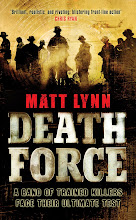
Fortunately, I’ve never been in a position where I haven’t like a cover. I’ve just received the jacket for ‘Shadow Force’ and I think it’s fantastic: exciting, direct, in keeping with the previous two books in the series, but different enough to mark out its own space. (Then again, when a book is about mercenaries and pirates, it’s quite hard not to come up with a decent jacket).
And, of course, authors shouldn’t assume they know what is the best cover for their book. The editor and the illustrator will have their own take on it, and how it fits into the market, who it is going to appeal to, and how it will stand out from the rest of the books on the market.
That said, it would be awful to see a cover you really didn’t like on your book. After all, it is the most obvious statement about your work.
Tuesday, 28 September 2010
Putting Voices To Characters:
I got a call out of the blue the other day from an actor called Paul Panting. He was about to start recording an audio version of Fire Force, and he wanted to have a chat about accents, as well as checking the pronunciation of some of the military hardware.
As anyone who has read either ‘Death Force’ or ‘Fire Force’ will know, there is a big group of character in the stories, and they all come from quite different places. Steve is South London, working class. Ollie is a public schoolboy. Dan is an Australian, Maksim a Russian, Chris a South African, and so on.
We were discussing what kind of voices to give the different men, and how far too push it. In the books, I don’t really give them different accents all the time, in the sense that, Chris, for example doesn’t talk about ‘Seth Eefrica’. That’s partly because I’m not very good at writing accents, but also because it could turn into an accent fest, and get very silly and distracting. I prefer to let their characters comes through by the type of things they say, and how they react to situations, rather than by giving them funny voices.
Paul and I agreed that that was the way to do it in the audio version as well – even if it meant he didn’t get a chance to show off all those accents he learned in acting school.
But it also struck me that just hearing the audio book – which I’m really looking forward to – is going to change my perception of the characters. I already hear Steve and Ollie’s voice in my head when I’m writing them, but of course an actor’s interpretation will be slightly different to mine. It will be fascinating, but also a bit strange to hear a different take on all the guys in the unit. It may even change the way I think about them.
Monday, 27 September 2010
Lay Off Vodafone.
In my Money Week column this week, I've been looking at how the City is constantly attacking Vodafone. Here is a taster...
What’s the most successful British company of the last twenty years? Tesco would be a contender, but it is still a marginal force outside of Britain, and lags Wal-Mart and Carrefour in the global retail market. Royal Bank of Scotland would have been a possibility until Sir Fred Goodwin blew the whole bank up. GlaxoSmithKline has been treading water since its 1980s to early 1990s heyday.
In fact the answer is easy. Vodafone.
The telecoms conglomerate has 347 million subscribers, and runs the largest mobile network in the world, measured by revenues, even if it is slightly behind China Mobile in terms of its total customer base. It operates networks in 31 countries, and has partners in another 44. Not bad for a company which three decades ago was just a small unit of the long-since forgotten Racal.
And yet you would hardly guess that from the way the City treats the business. The share price is beaten up. The chief executive Vittorio Colao is under constant pressure to dispose of assets. There is an endless stream of stories about how he should be selling his businesses in the US, or France, or somewhere else. Demands are tabled for special dividends and share buy-backs.
It is crazy – and an illustration of the City’s short-termism at its most destructive. There are plenty of criticisms that can justifiably be made of Vodafone. And yet the mobile industry is still in its infancy. Its play for global dominance may yet pay off. It may be able to take full control of units it holds minority stakes in. The City should be supporting once of the UK’s few industrial leaders, not trying to tear it apart.
The last week has seen yet another round of pressure on Colao to dismantle the empire that his predecessor Sir Chris Gent so expensively put together at the turn of the last decade. The company’s $6.5 billion stake in China Mobile was sold off, amid pressure for divestments. The 45% that it owns in Verizon Wireless, the largest mobile network in the US, is constantly under review. So to is the 44% stake it owns in the French operator SFR, of which Vivendi owns the other half. The 25% stake in Poland’s biggest mobile operator Polkomtel could be on the block. One shareholder group to lobby for the break-up of the business has been active since 2007. The demand for deals to boost shareholder returns builds all the time.
Some of the criticism is fair. Amid the telecoms bubble of the late 1990s, the company spent almost £200 billion on acquisitions. The $175 billion it paid for Germany’s Mannesmann remains one of the largest hostile takeovers ever attempted in Western Europe. Of the largest fifty deals of all time, Vodafone was a party to three of them. Shareholders didn’t see much of a return for all that frantic, and expensive, activity. Spending £200 billion only produced a company worth £85 billion today: not a great return, even if much of the money was in shares rather than cash. The share price has perked up this year – its dividend is one of the most generous and safest on the London market – but at just over 160p is still a long way short of the 444p it reached in March 2000.
But so what? All that is ancient history. The fact remains that whilst it may have over-paid for its acquisitions, Vodafone is today an industrial giant. No other mobile company comes close to its reach and scale in the mobile market: China Mobile may have more customers, but it doesn’t have anything like the same global reach.
There is still a good chance that its ambitions may pay off one day. No one knows precisely how the mobile industry will develop. It is, in truth, still in its infancy. It may end up destroying fixed line networks. It may merge with the computing and social networking industries. It may develop into something completely different. Whether having a global presence, in the way that Vodafone does, will pay off remains to be seen. It’s a gamble. But it is hardly a foolish one. Being the biggest gives you muscle in a market. It doesn’t guarantee success – there are plenty of big companies that completely mess up – but it’s a good place to be starting from.
Many of its minority stakes are frustrating. It hasn’t received any dividend on its Verizon shares since 2005: the two companies appear locked in a stand-off that makes the War of the Roses seem amicable and straightforward by comparison. Vivendi shows no interest in selling Vodafone majority control of the French operation they share. In some countries, it has already abandoned its ambitions. In Japan, for example, it sold out in 2006 after years of making little headway in one of the world’s most competitive, and technologically advanced, telecoms business.
But is still crazy to pressurize the company to sell out of successful businesses in France, Poland, and most crucially the US. It may be a long struggle to get control of Verizon. But the prize is surely worth having. Likewise, it doesn’t make much sense to sell out of the Polish market, which must surely have some of the best growth prospects in Europe. It may not have complete control of that business. But who is to say it won’t be able to win it one day.
Mobile telecoms is one of the world’s most lucrative and innovative consumer industries. For the UK to have the global leader is a remarkable achievement. It is an indictment of the City that it only wants to rip that apart – and can’t seem to see any virtue in supporting the company. The German stock market doesn’t try and break-up its most successful business, and neither does the Swiss or the Japanese. The London market should be more worried about supporting the country’s few world-class companies – and should spend a lot less time thinking about where the next deal is coming from.
Monday, 20 September 2010
How China Will Change Investment....
In my Money Week column this week, I've been looking at how the rise of China as the world's largest stock market will change investment. Here's a taster....
Any serious investor will already be comfortable with the emerging markets. They know the BRICs - Brazil, Russia, India and China - are doing a lot better than the traditional developed economies. They probably have some money in a fund specialising in those stocks. They might even have dipped into what the investment industry calls the frontier markets – places such as Pakistan, Tunisia, or Vietnam.
But over the next twenty years, the amount of attention they will need to pay to them is going to vastly increase. The emerging markets are going to stop emerging. They are going to turn into the establishment.
The mood of the global markets used to be set in London or New York. Over the next two decades, it will increasingly be set in Shanghai, Moscow on San Paulo. That is going to change the way the markets operate, the signals that suggest you should buy and sell, and the way that investors get rewarded. It will make investing a lot more scary, and the markets will be a lot a more volatile. But you need to get on the right side of that trend, or end up getting badly burned.
Last week, Goldman Sachs published a set of long-range forecasts for global stock market capitalisations. It predicted that by 2030, the value of emerging market
stocks would rise more than fivefold to $80 trillion. Their share of world equity capitalization would, the bank forecast, rise to 55% from 31% today. China will be the world’s largest market. Its total value, Goldman predicts, will increase to $41 trillion by 2030 from just $5 trillion today. It projects that the US market will be worth $34 trillion by then, making China easily the worlds biggest.
That will be a big change. Right now, the US stockmarket still accounts for almost 30% of global market capitalisation. China is just 7.2%, only a little ahead of the UK at 6.6%. Brazil accounts for only 2.8% of the world markets, just slightly more than Switzerland (although there are 205 million people in Brazil, compared to 7.6 million in Switzerland).
There is nothing very controversial about that. The emerging market economies are growing at a far healthier rate than either the US or Europe. The International Monetary Fund predicts the emerging economies will grow at 6.4% next year, compared with 2.4% for the developed world. They keep on growing at double or triple our rate every year. Nor is there any reason to expect that to slow down. The demographics of the developing world are in far better shape. So are government finances. And they still have a lot of catching up to do to match living standards in the West. It’s hardly a surprise that their stockmarket will overtake ours. A hundred years ago, New York surpassed London in importance. Fairly soon, Shanghai will overtake New York.
The interesting question is how that will impact on the way the markets work.
We are used to a world where the dominant investment themes and ideas are set mostly in New York, and partly in London. The Dow Jones index might just be thirty companies. Its rather strange composition might well mean that it isn’t even a very accurate reflection of the American economy, never mind what was happening in the rest of the world. As a general rule, however, if you knew what was happening to the Dow, you’d have a pretty good idea where the rest of the world’s markets were heading. Likewise, the FTSE is an oddball mix of companies, largely dominated by oil and mining companies, plus a big bank and drugs company. It doesn’t tell you much about the British economy. But if mining stocks are all the rage in London, you can be certain they will soon be just as popular in the rest of the world as well.
The themes in New York and London dominate the global markets everywhere. If dividends are in fashion in the U, they will be growing in importance globally. If stock buy-backs are a more popular way of rewarding investors in London, that will be replicated around the world.
Expect all that to change in the next twenty years. What will count is the mood in Shanghai, Moscow or San Paulo. The one number you really want to know won’t be the Dow: it will be the change in the Shanghai Composite. It will be the way those markets are developing, the way that money is flowing through them, and the demands that investors are making, which will set the tone for the global markets. European and American markets will take their cue from the emerging market, not the other way around.
That may well turn out to be scary for investors. It’s dated to portray the Shanghai index as an old-fashioned gangster market, with some mysterious Mr Chan sitting in a dark basement dictating whether it rises of falls with a click of his fingers. But it operates to very different rules to the stock markets of the West. It is heavily manipulated by the government. It has no clear and transparent rules governing what firms can be listed, and what they need to disclose to investors. It is not fully open to foreign investors. And the Chinese, who make up the bulk of investors, are inveterate gamblers, who have always thought stock markets should be casinos without the neon lights and cocktail bars rather than places where you try and seriously analyse a company’s likely future earnings. The critics who point out the New York and London market promote a casino culture, treating stocks like gambling chips, haven’t seen anything yet.
The stock market right now is volatile, short-termist and self-interested. But as it comes to be dominated by Shanghai and Moscow it is going to get a lot more so. The market will be dominated by the state, because that is the way that business works in China and Russia. It won’t be very interested in small investors, because they don’t count for very much in any of those markets. Nor are the standards of honesty likely to be the same.
There is no point complaining about that, however. It is where the money will be. The rules of investment are about to change, and investors need to make sure they understand that. Because one thing is always true: if you don’t understand the rules, then you haven’t much chance of winning the game.
Tuesday, 14 September 2010
Thriller Writers Need More Relevance
One of my favourite themes is how thriller writers aren’t keeping up with the times. Britain and the US have been involved in two major and very nasty wars in the last decade, both in Iraq and Afghanistan. But you wouldn’t guess it from reading the thrillers on the shelves at your local WH Smith. The y are all old-style Cold War spy thrillers, stuff about hidden scrolls, serial killers, or lawyers. There is almost nothing about the wars we are fighting now.
There is a fascinating piece related to that in the New York Times. It points out that the most vibrant story-telling about contemporary warfare is in the video game industry, not in the thriller industry. Games like Medal of Honour and Call of Duty are far more relevant to what is happening in the world today than just about any book.
I’m trying to address that with my ‘Death Force’ series, which are bang up to date. But not enough writers are taking up that challenge. I suspect that is partly the fault of the publishers, who should be looking for more contemporary material. But it also because writers have lost the desire to be relevant.
The video game already poses a big challenge for writers. In many ways it is a more interesting narrative form. But surely it is silly to leave the field completely top gaming, rather than the novel
Subscribe to:
Posts (Atom)





 Posts


