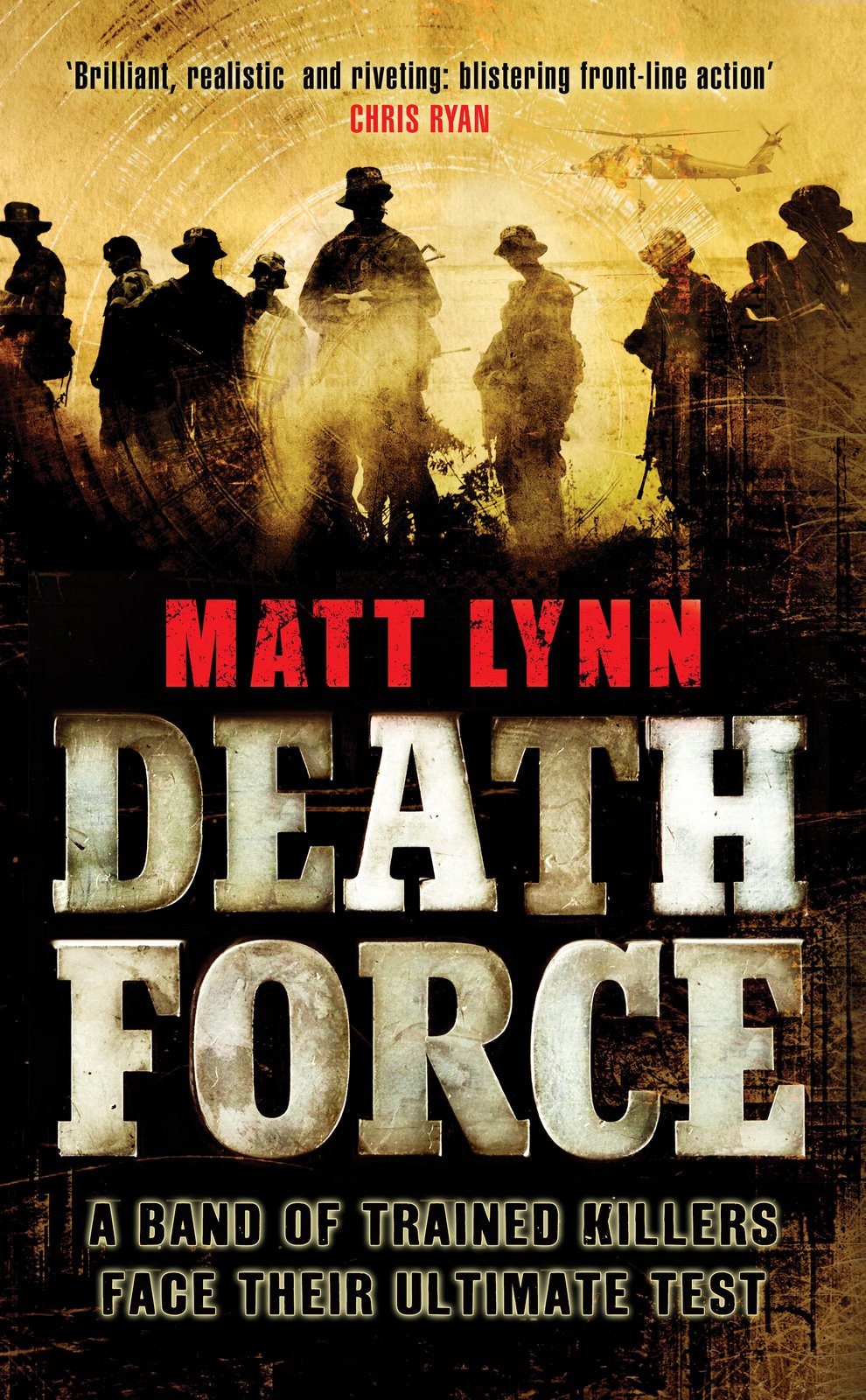
About the most interesting thing happening in the book trade right now is that the lines between traditional publishing and self-publishing are getting blurred. My Death Force series is published by Hodder Headline, but my Black Ops series of novellas I am bringing out myself.
More and more writers, so far as I can tell, are going down that road.
One indicator of that this week was the decision by the International Thriller Writer’s Association to allow its members to post the details of their self-published work up on their website. Until now, they had only allowed work bought out major publishers.
A hybrid model is emerging I suspect where writers do some work for major publishers, and some work for themselves, probably forming their own judgements on what mix will maximise their sales, income and creative satisfaction.
Personally I like the combination. I value the prestige of the mainstream publisher, and seeing my books in the shops. But I like the energy and immediacy of doing my own thing as well. And, I suspect I’ll soon be making more money as well.
But how exactly this is all going to work, however, no one really knows.
Showing posts with label writing. Show all posts
Showing posts with label writing. Show all posts
Sunday, 6 November 2011

Saturday, 29 October 2011
Will The Kindle Get Men to Read More?
If you haven’t bough one of the new Kindles yet, I really recommend it. It’s lighter than the old one, which makes it completely portable, but it is just as slickly designed, easy to read, and simple to use.
But I’ve noticed one thing about it. It fits perfectly into inside breast pocket of a man’s jacket. I’m a fairly averaged sized bloke – 42 jacket size if you must know – so I guess that is true for most men.
This is a more important point than most people realise. Men don’t normally have anywhere they can carry a book around. We don’t have handbags. Jacket and coat pockets are two small for printed books (unless you are going for the intellectual look, in which case you might have a copy of Camus stuffed into a big, grey coat). Unlike women, we don’t have anywhere we can slip a book away that we can read on the bus, or waiting for a meeting, or whatever.
On the whole women read more than men – that’s why women’s fiction sells more than men’s fiction. I’m not suggesting the Kindle is a male device – I’ve seen loads of women reading them on the train.
But it might well encourage men to read as much as women – which can only be a good thing.
But I’ve noticed one thing about it. It fits perfectly into inside breast pocket of a man’s jacket. I’m a fairly averaged sized bloke – 42 jacket size if you must know – so I guess that is true for most men.
This is a more important point than most people realise. Men don’t normally have anywhere they can carry a book around. We don’t have handbags. Jacket and coat pockets are two small for printed books (unless you are going for the intellectual look, in which case you might have a copy of Camus stuffed into a big, grey coat). Unlike women, we don’t have anywhere we can slip a book away that we can read on the bus, or waiting for a meeting, or whatever.
On the whole women read more than men – that’s why women’s fiction sells more than men’s fiction. I’m not suggesting the Kindle is a male device – I’ve seen loads of women reading them on the train.
But it might well encourage men to read as much as women – which can only be a good thing.
Tuesday, 20 September 2011
Swearing in Books
I had an e-mail this morning from a reader who said he was a big fan of my books, which was nice of course. But he also pointed out that the characters in the Death Force series used the word ‘sodding’ all the time, and it got a bit repetitive.
He’s right, of course. They do, and it is.
There is a reason, however. They are soldiers. In real life it would be fu%£kig this and f!c£king that. And for some reason, I don’t think swearing works very well in books. I don’t have anything against it in real life, and it can work fine in films, but I print it somehow falls flat.
So I use sodding instead.
But maybe that doesn’t quite work either?
He’s right, of course. They do, and it is.
There is a reason, however. They are soldiers. In real life it would be fu%£kig this and f!c£king that. And for some reason, I don’t think swearing works very well in books. I don’t have anything against it in real life, and it can work fine in films, but I print it somehow falls flat.
So I use sodding instead.
But maybe that doesn’t quite work either?
Wednesday, 8 June 2011
Writing On Trains...
I seem to have been on a lot of trains recently, which may help explain why I haven't had much time to blog recently. I went to Scotland to promote the Death Force books, and my book on the euro crisis is coming out in Germany soon, so I went there to help promote that. I don't really like flying very much, so in both cases I got the train.
It's a pleasant way to travel, although rather unexpectedly the German train broke down somewhere between Brussels and the border, which meant I had to get a bus the rest of the way to Cologne. Still, it's not as if planes don't get delayed all the time...and when a plane breaks down, it has a tendency to drop out of the sky.
But the best thing about trains is that they give you a chance to write.
I can write pretty well most places. I know some writers like to be in the same place all the time, but I'm quite happy to write in a cafe, or at home, or on a hotel balcony.
Overall, however, I think trains are my favourite.
There is something about the steady motion that aids the creative process. Looking out of the window creates a sense of the world going by, of events unfolding, which makes it very easy to create a similar sense of movement on the page. You can can pause, look out of the window for a while, then crack on with the next sentence. It is just the right amount of distraction. Not too little, but not too much either.
I suspect if I bought a euro-rail ticket and spent six months writing my next book on trains the effect would wear off.
But I got a lot of work done on those two trips.
It's a pleasant way to travel, although rather unexpectedly the German train broke down somewhere between Brussels and the border, which meant I had to get a bus the rest of the way to Cologne. Still, it's not as if planes don't get delayed all the time...and when a plane breaks down, it has a tendency to drop out of the sky.
But the best thing about trains is that they give you a chance to write.
I can write pretty well most places. I know some writers like to be in the same place all the time, but I'm quite happy to write in a cafe, or at home, or on a hotel balcony.
Overall, however, I think trains are my favourite.
There is something about the steady motion that aids the creative process. Looking out of the window creates a sense of the world going by, of events unfolding, which makes it very easy to create a similar sense of movement on the page. You can can pause, look out of the window for a while, then crack on with the next sentence. It is just the right amount of distraction. Not too little, but not too much either.
I suspect if I bought a euro-rail ticket and spent six months writing my next book on trains the effect would wear off.
But I got a lot of work done on those two trips.
Sunday, 1 May 2011
How To Make Money From Writing,,,,,
It might not always feel like it, but there is money in the thriller writing business….eventually. The TV channel Alibi has put together a list of the highest-earning crime and thriller writers, on both sides of the Atlantic. Ian Fleming is top of the British list, with earnings of a £100 million-plus, followed by Agatha Christie, and then by Jeffrey Archer (although I don’t think of him as a thriller writer).
Over in the US, it is headed by John Grisham on an extraordinary $600 million, followed by Dan Brown on $400 million – although I reckon if work it out per book, Brown has done better.
Are there any lessons in this for the rest of us writers? Two, I think. The first is that it takes a long time. All the writers on both lists have been writing for a long time – even Dan Brown published his first book in 1998 and it was a while before he had any success.
The second is that you have to write a lot. All the writers on the list are prolific, knocking out book after book. There are no one-hit wonders.
Anyway, I guess the moral is to keep plugging away. Riches await….although hopefully not after I’m dead.
Over in the US, it is headed by John Grisham on an extraordinary $600 million, followed by Dan Brown on $400 million – although I reckon if work it out per book, Brown has done better.
Are there any lessons in this for the rest of us writers? Two, I think. The first is that it takes a long time. All the writers on both lists have been writing for a long time – even Dan Brown published his first book in 1998 and it was a while before he had any success.
The second is that you have to write a lot. All the writers on the list are prolific, knocking out book after book. There are no one-hit wonders.
Anyway, I guess the moral is to keep plugging away. Riches await….although hopefully not after I’m dead.
Tuesday, 8 March 2011
Amazon Reviews....
There’s a lovely piece in The Guardian today by Christina Martin about Amazon reviews. Apparently, there has been more controversy about authors writing their own reviews (how could they – the cads!) and whether the reviews are really reliable.
She makes the valuable point that they may or may not be real. It doesn’t really matter. You can fairly easily tell which ones are genuine and which ones are fakes by the way they are written, and whether the person has reviewed similar books. And they open up the debate about books to lots of new voices. After all, before we had to rely on the reviews on the back of book jackets – and they were often fairly fictitious as well.
Most authors have an ambivalent attitude to Amazon and other online reviews. Personally I like them. I’ve had good ones and stinkers, and although none of us like being criticised, I can take that in good spirit. The internet is full of nasty stuff, and there is no reason why authors should be exempt. Online reviews are one of the few ways we have of getting feedback on our work, and of judging how much impact it is making on the world.
The more of them the better – even if they aren’t real.
She makes the valuable point that they may or may not be real. It doesn’t really matter. You can fairly easily tell which ones are genuine and which ones are fakes by the way they are written, and whether the person has reviewed similar books. And they open up the debate about books to lots of new voices. After all, before we had to rely on the reviews on the back of book jackets – and they were often fairly fictitious as well.
Most authors have an ambivalent attitude to Amazon and other online reviews. Personally I like them. I’ve had good ones and stinkers, and although none of us like being criticised, I can take that in good spirit. The internet is full of nasty stuff, and there is no reason why authors should be exempt. Online reviews are one of the few ways we have of getting feedback on our work, and of judging how much impact it is making on the world.
The more of them the better – even if they aren’t real.
Tuesday, 8 February 2011
Getting Voices Right...
As I might have mentioned last week, I am making revisions to ‘Ice Force’ right now. For me, that mainly means working on the language, and in particular the dialogue.
One of the hardest things writers have to do is give all the people in the their book a distinctive voice, and that is something I find I have to continually check. It is especially hard for me, because there are ten characters in the military unit in my stories, and although some of them are more important than others, they are all pretty crucial to the series.
So I need to make sure they all speak in a way that is convincing throughout the book, and which also separates one man from another.
I don’t do it through accents. That is partly, if I am being honest, because I am rubbish at writing them. I have no ear for putting a Welsh accent into easily written form. But its mainly because I think it is distracting. You don’t want the book to turn into an exercise in showing off how good I am at accents.
Instead you have to do it by the kinds of things the men say. It is there in the way they react to situations, how they respond to jokes, and in the kind of ideas and thoughts they have.
But you need to have thought through your character completely to know what they would say all the time.
And you need to make sure they never say anything out of character. That would shatter the illusion for the reader in an instant.
When you get it right, it is very satisfying. The right dialogue really makes a book come alive.
But you have to keep checking you haven’t got any of it wrong.
One of the hardest things writers have to do is give all the people in the their book a distinctive voice, and that is something I find I have to continually check. It is especially hard for me, because there are ten characters in the military unit in my stories, and although some of them are more important than others, they are all pretty crucial to the series.
So I need to make sure they all speak in a way that is convincing throughout the book, and which also separates one man from another.
I don’t do it through accents. That is partly, if I am being honest, because I am rubbish at writing them. I have no ear for putting a Welsh accent into easily written form. But its mainly because I think it is distracting. You don’t want the book to turn into an exercise in showing off how good I am at accents.
Instead you have to do it by the kinds of things the men say. It is there in the way they react to situations, how they respond to jokes, and in the kind of ideas and thoughts they have.
But you need to have thought through your character completely to know what they would say all the time.
And you need to make sure they never say anything out of character. That would shatter the illusion for the reader in an instant.
When you get it right, it is very satisfying. The right dialogue really makes a book come alive.
But you have to keep checking you haven’t got any of it wrong.
Tuesday, 1 February 2011
Revisions, Revisions....
I finished the first draft of ‘Ice Force’ last week, so now all I have to do is revise the manuscript before I hand it in to Headline. I enjoy revisions. As I’ve pointed out before on this blog, I plan my plots in a lot of detail before I start writing the book, so the difference between the first and second draft is not going to include any very radical re-working of the storyline.
Instead, it is all about the prose. I write a book straight through. I don’t go back and re-read anything until the whole book is done. So when I am revising, there is a fair amount of tinkering around to be done. But it is mainly about tuning up sentences, and punching up dialogue. That is all fun. It’s probably the bit of the job I enjoy the most.
But I was struck by a post on Roy Greenslade’s blog this week about how Rudyard Kipling revised his work.
"Take well-ground Indian ink as much as suffices and a camel hairbrush proportionate to the intersperse of your lines,” Kipling advised.
In an auspicious hour, read your final draft and consider faithfully every paragraph, sentence and word, blacking out where requisite.
Let it lie by to drain as long as possible. At the end of that time, re-read and you should find that it will bear a second shortening. Finally, read it aloud alone and at leisure.
May be a shade more brushwork will then indicate or impose itself. If not, praise Allah, and let it go and when thou hast done, repent not."
Kipling, as Greenslade points out, was talking about his newspaper pieces in India. But much the same advice applies to a book as well. Obviously we can skip the bit about the Indian ink. Apart from that, it is good stuff. Always read it carefully, put it aside for a while, then read it again. And once it is done, stop worrying about it.
The one thing I don’t do is read it aloud. But I think it might be a good idea. Words and sentences have a different flow when read out loud, and they might well be improved. I might try that this time around.
Instead, it is all about the prose. I write a book straight through. I don’t go back and re-read anything until the whole book is done. So when I am revising, there is a fair amount of tinkering around to be done. But it is mainly about tuning up sentences, and punching up dialogue. That is all fun. It’s probably the bit of the job I enjoy the most.
But I was struck by a post on Roy Greenslade’s blog this week about how Rudyard Kipling revised his work.
"Take well-ground Indian ink as much as suffices and a camel hairbrush proportionate to the intersperse of your lines,” Kipling advised.
In an auspicious hour, read your final draft and consider faithfully every paragraph, sentence and word, blacking out where requisite.
Let it lie by to drain as long as possible. At the end of that time, re-read and you should find that it will bear a second shortening. Finally, read it aloud alone and at leisure.
May be a shade more brushwork will then indicate or impose itself. If not, praise Allah, and let it go and when thou hast done, repent not."
Kipling, as Greenslade points out, was talking about his newspaper pieces in India. But much the same advice applies to a book as well. Obviously we can skip the bit about the Indian ink. Apart from that, it is good stuff. Always read it carefully, put it aside for a while, then read it again. And once it is done, stop worrying about it.
The one thing I don’t do is read it aloud. But I think it might be a good idea. Words and sentences have a different flow when read out loud, and they might well be improved. I might try that this time around.
Monday, 17 January 2011
How To Plan A Book
Over on the International Thriller Writer's site I've been leading a discussion on whether to plan a novel in advance. Here's my contribution, but you can read the rest of the debtate there.
Before starting the ‘Death Force’ series a couple of years ago, I spent about five years as a ghost-writer for Random House. I churned out seven action-adventure thrillers, books that were supposedly written by spies and special forces guys.
In many ways it was a frustrating experience. You get quite well-paid, but you don’t get any credit for your work.
But it did teach me one really useful thing – the importance of planning your plot.
When you are ghost-writing, you need to get the ‘author’ and publisher on board. The last thing I wanted to do was spend months on a book, and then get told it wasn’t what they wanted. So I started writing incredibly detailed outlines. I’d do a 15,000 word outline for a 100,000 word book. Every chapter and incident would be detailed, bits of dialogue, and character development. Then I’d make sure everyone was signed up to it.
And you know what. I found it was a tremendous discipline. It forced me to really think ruthlessly about where the plot was going. It forced me to think hard about turning point, and twists, and to fitting the characters into the story. And it made me much better at chucking things out – I could edit much more fiercely on an outline than I ever could on a finished manuscript.
So now that I am writing my own books I still do these incredibly detailed outlines.
And that has two big advantages.
First, the plots are much better. They start in the right place, they are tighter and leaner, and more exciting.
Second, when I’m writing the actually book, I don’t have to worry about plot and structure because that is already done. I can focus on jokes, dialogue, one-liners, terrific action descriptions, and all the other stuff that goes into a first-class thriller.
So if there is one piece of advice I would always give an aspiring writer it is – plan, plan, plan.
Before starting the ‘Death Force’ series a couple of years ago, I spent about five years as a ghost-writer for Random House. I churned out seven action-adventure thrillers, books that were supposedly written by spies and special forces guys.
In many ways it was a frustrating experience. You get quite well-paid, but you don’t get any credit for your work.
But it did teach me one really useful thing – the importance of planning your plot.
When you are ghost-writing, you need to get the ‘author’ and publisher on board. The last thing I wanted to do was spend months on a book, and then get told it wasn’t what they wanted. So I started writing incredibly detailed outlines. I’d do a 15,000 word outline for a 100,000 word book. Every chapter and incident would be detailed, bits of dialogue, and character development. Then I’d make sure everyone was signed up to it.
And you know what. I found it was a tremendous discipline. It forced me to really think ruthlessly about where the plot was going. It forced me to think hard about turning point, and twists, and to fitting the characters into the story. And it made me much better at chucking things out – I could edit much more fiercely on an outline than I ever could on a finished manuscript.
So now that I am writing my own books I still do these incredibly detailed outlines.
And that has two big advantages.
First, the plots are much better. They start in the right place, they are tighter and leaner, and more exciting.
Second, when I’m writing the actually book, I don’t have to worry about plot and structure because that is already done. I can focus on jokes, dialogue, one-liners, terrific action descriptions, and all the other stuff that goes into a first-class thriller.
So if there is one piece of advice I would always give an aspiring writer it is – plan, plan, plan.
Monday, 10 January 2011
Why Stories Matter...
Over at The International Thriller Writers Website, I've been leading a discussion on why stories matter. You can read the other contributions there, but here's what I had to say.
Why do stories matter? It’s a good question for a writer to ask themselves. If you made cars, or taught kindergarten, or worked as a farmer, it would be much easier. Your work matters because people need it. It fulfils some function. But do people need stories? What function do they have?
You could argue – not much. After all, they are just a made up series of events.
I think they do have a function. After all, we’ve been telling stories ever since cavemen sat around the first camp fires. Probably a fair numbers of those stories were thrillers (featuring hair-raising bison chases, and the inevitable double-dealing Neanderthal). A fair number would have been romances as well. It must be the case that stories perform some kind of useful function, otherwise they wouldn’t have been a feature of very human society we’ve ever known. Their function might not be obvious, like a spade, but that doesn’t mean it isn’t there.
So what is it? In my view, the function of a story is to make sense of the world. Its takes the chaos and randomness of life and gives it some sort of shape and purpose. In fiction, there are no co-incidences, and no loose ends. That isn’t always terribly realistic. But it is a lot more satisfying for the reader because it helps to make the world seem a more structured, ordered place than it probably really is. It helps make us feel our lives move towards a destination, rather than just wander around. Along the way they may also be entertaining, diverting, amusing and sometimes even educational. But that is their core function – and realising that helps you to become a better writer.
Why do stories matter? It’s a good question for a writer to ask themselves. If you made cars, or taught kindergarten, or worked as a farmer, it would be much easier. Your work matters because people need it. It fulfils some function. But do people need stories? What function do they have?
You could argue – not much. After all, they are just a made up series of events.
I think they do have a function. After all, we’ve been telling stories ever since cavemen sat around the first camp fires. Probably a fair numbers of those stories were thrillers (featuring hair-raising bison chases, and the inevitable double-dealing Neanderthal). A fair number would have been romances as well. It must be the case that stories perform some kind of useful function, otherwise they wouldn’t have been a feature of very human society we’ve ever known. Their function might not be obvious, like a spade, but that doesn’t mean it isn’t there.
So what is it? In my view, the function of a story is to make sense of the world. Its takes the chaos and randomness of life and gives it some sort of shape and purpose. In fiction, there are no co-incidences, and no loose ends. That isn’t always terribly realistic. But it is a lot more satisfying for the reader because it helps to make the world seem a more structured, ordered place than it probably really is. It helps make us feel our lives move towards a destination, rather than just wander around. Along the way they may also be entertaining, diverting, amusing and sometimes even educational. But that is their core function – and realising that helps you to become a better writer.
Wednesday, 22 December 2010
The Middle of a Book.
I did an interview the other day with Write Words. One of the questions was what is the worst thing about writing? I found that a hard one, because on the whole I really enjoy writing, which is I guess why I do it for a living.
But in the end I answered: the middle. The beginning of a book is exciting, because it is a fresh start. And you always think you are about to write the most amazing book ever.
And the end is exciting, because it’s nearly finished, and you can see how the whole thing looks.
But there is a chunk in the middle, between about 40,000 and 60,000 words, where it is all a bit of a slog. It’s then you need to dig deep to find the will to get it finished, and not to get distracted.
I’m there right now with ‘Ice Force’. Getting up to about 60,000 words though, so hopefully after Christmas I’ll be into the home straight.
But in the end I answered: the middle. The beginning of a book is exciting, because it is a fresh start. And you always think you are about to write the most amazing book ever.
And the end is exciting, because it’s nearly finished, and you can see how the whole thing looks.
But there is a chunk in the middle, between about 40,000 and 60,000 words, where it is all a bit of a slog. It’s then you need to dig deep to find the will to get it finished, and not to get distracted.
I’m there right now with ‘Ice Force’. Getting up to about 60,000 words though, so hopefully after Christmas I’ll be into the home straight.
Wednesday, 8 December 2010
Let It Snow
It’s cold at the moment, as you’ve probably noticed. Everyone else has, understandably enough, been moaning about the weather. But when you are half way through writing a book called ‘Ice Force’ it does have certain advantages. When I need to get in the mood for another description of snow storms swirling through the Arctic glaciers, all I have to do is step out into the garden.
One of the things you have to do as writer is create a believable atmosphere. Books vary, of course. Some are set in very, ordinary everyday locations -- the suburbs, for example. I like to set my books in fairly exotic places. I think that is part of the appeal of the adventure-action thriller genre. There is a big element of escapism in these books. Nobody wants to escape to Swindon. They want the book to take them somewhere exciting, and preferably dangerous as well.
That does, of course, mean the writer has to create believable detail. You need to make it real, without overdoing the travelogues. The best way is to focus on little things. When I was writing about Helmand in Afghanistan for Death Force, for example, I mentioned the smell of the wild irises that grow in the mountains along the Afghan-Pakistan border. In Ice Force, I’ve mentioned the grinding noise that the plates of ice moving beneath you make as you trudge towards the North Pole.
The atmosphere has to be woven into every sentence you write.
And, of course, it helps if it is snowing outside while you are doing it.
One of the things you have to do as writer is create a believable atmosphere. Books vary, of course. Some are set in very, ordinary everyday locations -- the suburbs, for example. I like to set my books in fairly exotic places. I think that is part of the appeal of the adventure-action thriller genre. There is a big element of escapism in these books. Nobody wants to escape to Swindon. They want the book to take them somewhere exciting, and preferably dangerous as well.
That does, of course, mean the writer has to create believable detail. You need to make it real, without overdoing the travelogues. The best way is to focus on little things. When I was writing about Helmand in Afghanistan for Death Force, for example, I mentioned the smell of the wild irises that grow in the mountains along the Afghan-Pakistan border. In Ice Force, I’ve mentioned the grinding noise that the plates of ice moving beneath you make as you trudge towards the North Pole.
The atmosphere has to be woven into every sentence you write.
And, of course, it helps if it is snowing outside while you are doing it.
Wednesday, 24 November 2010
A Moment to Celebrate Ourselves
It was National Freelancer’s Day yesterday, although not very surprisingly I missed it. Indeed, I suspect that all the freelancers out there missed it: partly because they are always very, very busy with other stuff; and partly because, by definition, we all work by ourselves, so we aren’t around other freelancers, who might remind us to celebrate.
Still, the Telegraph had an interesting survey to mark the occasion. It found that freelancers were on the whole happier than people who had jobs. Not very surprising, really. If you consider that most jobs consist of some idiot shouting at you all morning, then getting a terrible, over-priced sandwich that tastes like mouldy cardboard, with some bloke you’re only friends with because he happens to sit next to you, and then spending the afternoon in a crushingly dull meeting, it is surprising that us freelancers aren’t even further in the lead.
Its ten years now since I had a job in an office, so I’ve spent a decade now sitting around at home writing stuff. It takes a lot of discipline, of course. You have to get up in the morning and crack on with your work. You need to set yourself targets and deadlines.
And it has it ups and downs. But when you hit a down it is worth remembering that you are a lot happier than you would be in an officer.
In fact next year I might even celebrate National Freelancers Day – possibly with a plate of foie gras and a glass of Bordeaux at my desk.
Still, the Telegraph had an interesting survey to mark the occasion. It found that freelancers were on the whole happier than people who had jobs. Not very surprising, really. If you consider that most jobs consist of some idiot shouting at you all morning, then getting a terrible, over-priced sandwich that tastes like mouldy cardboard, with some bloke you’re only friends with because he happens to sit next to you, and then spending the afternoon in a crushingly dull meeting, it is surprising that us freelancers aren’t even further in the lead.
Its ten years now since I had a job in an office, so I’ve spent a decade now sitting around at home writing stuff. It takes a lot of discipline, of course. You have to get up in the morning and crack on with your work. You need to set yourself targets and deadlines.
And it has it ups and downs. But when you hit a down it is worth remembering that you are a lot happier than you would be in an officer.
In fact next year I might even celebrate National Freelancers Day – possibly with a plate of foie gras and a glass of Bordeaux at my desk.
Tuesday, 9 November 2010
Why I Write Thrillers...
The International Thriller Writers website has started a series of online round-table discussions about thriller writing – sort of like a conference panel, bit without all the travelling.
I’ll be taking part in a couple of the upcoming discussions. But I think the first in the series looks really good: ‘Why Do You Read/Write Thrillers’.
It’s a fascinating issue for any writer. I mean, obviously I love thrillers. But I don’t only love thrillers. There are loads of different kinds of books I really enjoy, and I would be just as happy to write.
In the discussion, I think Todd Ritter gives the best answer when he says: “Reading a thriller that makes my pulse race takes me briefly into a world of danger and fear and excitement that I won’t experience in real life. It’s an escape and, well, a thrill”.
Still, that is more of an answer to the question of why you read thrillers rather than why you write them.
For me, I think the answer is that the thriller is such a great canvass. They are widescreen stories. They have action, characters, jokes and drama, but they can also take in politics, economics, war, technology, and international relations. They are very outwards looking books, which weave stories out of current events, but which also, at their best, are timeless. Other genres tend to be much smaller scale, rooted in one place or time.
But I guess every thriller writer will have a different answer to the question.
I’ll be taking part in a couple of the upcoming discussions. But I think the first in the series looks really good: ‘Why Do You Read/Write Thrillers’.
It’s a fascinating issue for any writer. I mean, obviously I love thrillers. But I don’t only love thrillers. There are loads of different kinds of books I really enjoy, and I would be just as happy to write.
In the discussion, I think Todd Ritter gives the best answer when he says: “Reading a thriller that makes my pulse race takes me briefly into a world of danger and fear and excitement that I won’t experience in real life. It’s an escape and, well, a thrill”.
Still, that is more of an answer to the question of why you read thrillers rather than why you write them.
For me, I think the answer is that the thriller is such a great canvass. They are widescreen stories. They have action, characters, jokes and drama, but they can also take in politics, economics, war, technology, and international relations. They are very outwards looking books, which weave stories out of current events, but which also, at their best, are timeless. Other genres tend to be much smaller scale, rooted in one place or time.
But I guess every thriller writer will have a different answer to the question.
Tuesday, 2 November 2010
Writing ....Fast or Slow
In case you hadn’t noticed, this is National Novel Writing Month. An American initiative, it aims to get people writing a whole novel during November. It doesn’t make much difference in my house, of course. Just about every month is novel writing month for me. But the Independent has an interesting take on it, listing some of the great books that have been written in a few weeks. I’m not sure why they included Sebastian Faulk’s James Bond pastiche ‘Devil May Cry’, because it is a laughably poor book. But it has to be admitted there are some great books there. ‘On The Road’ for example took only three weeks. So did ‘A Study in Scarlet’, and ‘A Christmas Carol’. Even Dostoyevsky managed to knock out ‘The Gambler’ in only 26 days – although he doesn’t strike you as a fast sort of a writer, in the way that Dickens does.
So is it better for writers to rattle out a book fairly quickly? I certainly think there is something to be said for it, particularly when you are writing thrillers. They are by definition pacey books. A sense of speed is one of the things that readers like about them. Like roller-coasters, they need to be designed to go very fast, and have lots of twists and turns. It is easier to create that kind of breathlessness when you are working at high speed yourself.
That said, you don’t want that to turn into sloppiness. The other key element of a thriller is structure. And that takes time to build. There is nothing worse than reading a book that is all over the place, because the writer hasn’t taken enough time to construct the plot, or do the research.
My own solution is to spend ages on the outline – the structure – but then to write pretty quickly. But I’m sure every writer has their own approach.
So is it better for writers to rattle out a book fairly quickly? I certainly think there is something to be said for it, particularly when you are writing thrillers. They are by definition pacey books. A sense of speed is one of the things that readers like about them. Like roller-coasters, they need to be designed to go very fast, and have lots of twists and turns. It is easier to create that kind of breathlessness when you are working at high speed yourself.
That said, you don’t want that to turn into sloppiness. The other key element of a thriller is structure. And that takes time to build. There is nothing worse than reading a book that is all over the place, because the writer hasn’t taken enough time to construct the plot, or do the research.
My own solution is to spend ages on the outline – the structure – but then to write pretty quickly. But I’m sure every writer has their own approach.
Tuesday, 26 October 2010
Don't Diss Jane Austen....
Jane Austen has been getting some flak in the press, although I guess she can survive it. An academic has been studying her letters, noted how confused they are, and how different they are from her books, and concluded that her editor must have done a lot of re-writes on her books.
That story got lots of play in newspapers, and on the web. For some reason, people like the notion that authors don’t really write their own stuff, and there is some team of the people in the publishing house who actually put the book together
But anyway, whoever came up with this piece of research obviously knows very little about how writers actually work. There is a big difference between the writing we do for a living, which on the whole we take very seriously, edit and polish and worry about, and the writing we do like everyone else, which is dashed off without much thought.
Now obviously I don’t have much in common with Austen. I’m better at tank battles, for starters. Plus I’m still alive. But my e-mails, letters, Xmas cards, and indeed blog entries might well lead you to conclude that I couldn’t possibly have written my books either.
But, of course I did. And so, of course, did Jane Austen.
That story got lots of play in newspapers, and on the web. For some reason, people like the notion that authors don’t really write their own stuff, and there is some team of the people in the publishing house who actually put the book together
But anyway, whoever came up with this piece of research obviously knows very little about how writers actually work. There is a big difference between the writing we do for a living, which on the whole we take very seriously, edit and polish and worry about, and the writing we do like everyone else, which is dashed off without much thought.
Now obviously I don’t have much in common with Austen. I’m better at tank battles, for starters. Plus I’m still alive. But my e-mails, letters, Xmas cards, and indeed blog entries might well lead you to conclude that I couldn’t possibly have written my books either.
But, of course I did. And so, of course, did Jane Austen.
Wednesday, 8 September 2010
Fact vs Fiction....
Fact vs Fiction:
I haven’t been writing very much on this blog, largely because I’ve been rattling out a quick book on the Greek crisis for Wiley. The book was written at huge speed – a couple of months – and will be out in November. That was exhilarating in itself. As most of us know, the process of writing can be pretty leisurely. It takes a long time to write a book, and just as long for the publisher to bring it out. This one will be about five months total from Wiley getting in touch about the idea to the book hitting the shelves.
For me, it was also a chance to reflect on the difference between writing fact and fiction. I wrote a couple of business books much earlier in my career, but this was the first one I had done since I took up writing fiction.
It is a very different process. Obviously, the non-fiction book involves a lot more research. On the other hand, the story is just there. You collect the facts, marshal them into a coherent argument, then tell the story.
In fiction, you have to create every detail of the story yourself. You have to create the characters, and make them real. You need twists and denouements. It’s far harder work.
The funny thing is, most people looking at ‘Bust’ would assume it was a far more serious book than, say, ‘Fire Force’. But a book like ‘Fire Force’ is far more difficult to write.
I haven’t been writing very much on this blog, largely because I’ve been rattling out a quick book on the Greek crisis for Wiley. The book was written at huge speed – a couple of months – and will be out in November. That was exhilarating in itself. As most of us know, the process of writing can be pretty leisurely. It takes a long time to write a book, and just as long for the publisher to bring it out. This one will be about five months total from Wiley getting in touch about the idea to the book hitting the shelves.
For me, it was also a chance to reflect on the difference between writing fact and fiction. I wrote a couple of business books much earlier in my career, but this was the first one I had done since I took up writing fiction.
It is a very different process. Obviously, the non-fiction book involves a lot more research. On the other hand, the story is just there. You collect the facts, marshal them into a coherent argument, then tell the story.
In fiction, you have to create every detail of the story yourself. You have to create the characters, and make them real. You need twists and denouements. It’s far harder work.
The funny thing is, most people looking at ‘Bust’ would assume it was a far more serious book than, say, ‘Fire Force’. But a book like ‘Fire Force’ is far more difficult to write.
Thursday, 13 May 2010
How To Distinguish Characters....
I did an event up in Essex last night with two of my fellow Headline authors, Barbara Nadel and Michael Stanley. As is so often the case, I was really impressed by the quality of the questions people asked.
There was one that set me thinking a fair bit: How do you distinguish characters from one another.
I waffled away for a fair bit, but it was a good question, and one I probably haven’t thought about enough. I quite often read a book and find I get lost because the characters all blur into one. It’s particularly pressing in my case, because the ‘Death Force’ series features eight or nine main characters. And superficially at least they are quite similar: soldiers, blokes, etc.
It struck me later that in opera, each character has a theme, or maybe just a key, and that helps the listener tell them apart. And there is a clue in that for construction a novel. What I try and do is give each character a theme, or key: some fairly simple, but compelling, place they are trying to get to, or a demon they are trying to kill, or a journey they are trying to complete.
On top of that, you need to give them a voice. A way of speaking, and a way of fitting into the group. And you need to give them some really deep back story, so you know precisely where they are coming from.
But there is no doubt it is one of the hardest things a writer has to do.
There was one that set me thinking a fair bit: How do you distinguish characters from one another.
I waffled away for a fair bit, but it was a good question, and one I probably haven’t thought about enough. I quite often read a book and find I get lost because the characters all blur into one. It’s particularly pressing in my case, because the ‘Death Force’ series features eight or nine main characters. And superficially at least they are quite similar: soldiers, blokes, etc.
It struck me later that in opera, each character has a theme, or maybe just a key, and that helps the listener tell them apart. And there is a clue in that for construction a novel. What I try and do is give each character a theme, or key: some fairly simple, but compelling, place they are trying to get to, or a demon they are trying to kill, or a journey they are trying to complete.
On top of that, you need to give them a voice. A way of speaking, and a way of fitting into the group. And you need to give them some really deep back story, so you know precisely where they are coming from.
But there is no doubt it is one of the hardest things a writer has to do.
Wednesday, 28 April 2010
Why Do Readers Read....
One of the interesting questions for any writer is why do readers read? There have been a couple of interesting articles recently about 'neuro- lit crit' (such as this one in the New York Times, or this one in The Guardian).
I won't try and get into the science of it too much, because clearly I'm not qualified to. And I'd probably get the wrong end of the stick anyway. But from the perspective of a writer, it's obviously helpful to understand why people like stories, and what triggers they pull in their brains.
Of the different theories, I was most impressed by the approach of the evolutionary biologists. They suggest we like certain types of stories because they help us think through survival strategies. So for example, the bulk of women's fiction is about finding a suitable mate (except with a few jokes thrown in).
And what about crime and thrillers? I'd suggest it's about identifying danger, and how you'd cope with it.
It's certainly a different way of thinking about story construction.
I won't try and get into the science of it too much, because clearly I'm not qualified to. And I'd probably get the wrong end of the stick anyway. But from the perspective of a writer, it's obviously helpful to understand why people like stories, and what triggers they pull in their brains.
Of the different theories, I was most impressed by the approach of the evolutionary biologists. They suggest we like certain types of stories because they help us think through survival strategies. So for example, the bulk of women's fiction is about finding a suitable mate (except with a few jokes thrown in).
And what about crime and thrillers? I'd suggest it's about identifying danger, and how you'd cope with it.
It's certainly a different way of thinking about story construction.
Thursday, 25 March 2010
Writing A Short Story
I’ve just been writing a short story for the Red Bull magazine that goes out with The Independent. Funnily enough, despite having written quite a few novels, both under my own name, and under other people’s, I found it really difficult to get started.
A lot of people graduate from short stories to novels, but it is quite hard to go the other way. I’m used to the flow of a novel. I have the structure pretty much hard-wired into my brain. I know when to speed up, slow down, how to develop the characters, and so on.
But a short story is 2,000 words. It’s hardly any space at all to get a story started, never mind finish the whole thing. It’s more like an anecdote than an adventure.
Anyway, in the end I think I did ok.
But it was a very steep learning curve.
A lot of people graduate from short stories to novels, but it is quite hard to go the other way. I’m used to the flow of a novel. I have the structure pretty much hard-wired into my brain. I know when to speed up, slow down, how to develop the characters, and so on.
But a short story is 2,000 words. It’s hardly any space at all to get a story started, never mind finish the whole thing. It’s more like an anecdote than an adventure.
Anyway, in the end I think I did ok.
But it was a very steep learning curve.
Subscribe to:
Posts (Atom)




 Posts
Posts


